
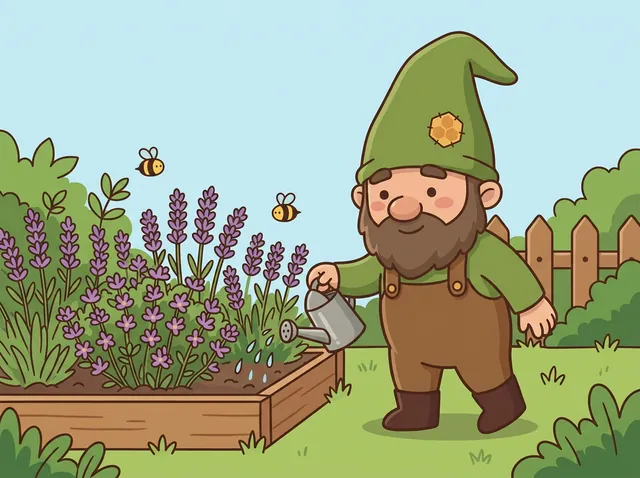

Thymian says: for bees, a garden is a dining table. The longer something is in bloom during the year, the better they are fed, from the first early bloomers to the herbs of late summer.
Contents
Thymian’s garden year
Bees need flowers from the first warm day of spring right into autumn. In spring there is usually enough in bloom. Things get tight in late summer and autumn, just when the colony is raising its winter bees. Planting for that time helps most.
Early spring: the first meals
- Snowdrops, crocus, winter aconite – small bulb flowers for the first warm days.
- Willows – their catkins are among the first blossoms of the bee year.
Spring: the grand entrance
- Fruit trees – cherry, apple, pear, plum.
- Dandelion – please don’t mow it straight away.
- Berry bushes – redcurrant and the like bloom quietly, but bees find them.
- Maple and horse chestnut – big trees, big table.
Early summer and summer: linden time
- Black locust and linden – their blossoms become acacia and linden honey.
- Sage, thyme, lavender – herbs that smell of summer.
- Borage and phacelia – easy to grow from seed.
- Meadow clary – lever and barrier for bumblebees.
- Cornflower and clover – for the meadow or a strip along the edge.
Late summer and autumn: the most important time
- Sunflower – a head full of pollen.
- Stonecrop and asters – they bloom when little else does.
- Brown knapweed – purple right into autumn.
- Heather – late summer in purple.
- Rosebay willowherb – pink flowers in forest clearings.
- Goldenrod – native or introduced.
- Ivy – one of the last of the year.
Did you know? Double ornamental flowers look magnificent, but in them the stamens have turned into petals. Bees only find pollen in simple, single flowers.
Don’t forget the wild bees
According to the City of Leipzig’s catalogue of measures, 314 bee species are known there, and many of them are considered extinct or missing. Wild bees are protected by the Federal Species Protection Ordinance (Bundesartenschutzverordnung); honey bees are not. Where little is in bloom and many bees are flying, competition for food can arise. If you sow, use seed native to the region and species that flower early or late. Viper’s bugloss, for example, helps the viper’s bugloss mason bee (Natternkopf-Mauerbiene).
Everything on wild bees at a glance: Wild bees in Leipzig and in the garden.
Thymian’s three rules
1. Don’t mow everything. A corner with dandelion and clover is a feast for bees.
2. Put out water. A shallow dish with stones – bees need a drink break too.
3. No poisons. Anyone who invites bees does not spray insecticides.
On the balcony
A balcony box helps too: thyme, lavender, sage, borage and chives – let them flower! – grow in pots, and bees love to visit them.


