

I have to be honest about the linden: it is a big tree. According to the Baden-Württemberg bee forage catalogue, the small-leaved linden (Tilia cordata) grows 10 to 30 metres tall, the large-leaved linden (Tilia platyphyllos) 15 to 40 metres. That is nothing for a balcony, more for a big garden or a courtyard.
Contents
The two lindens
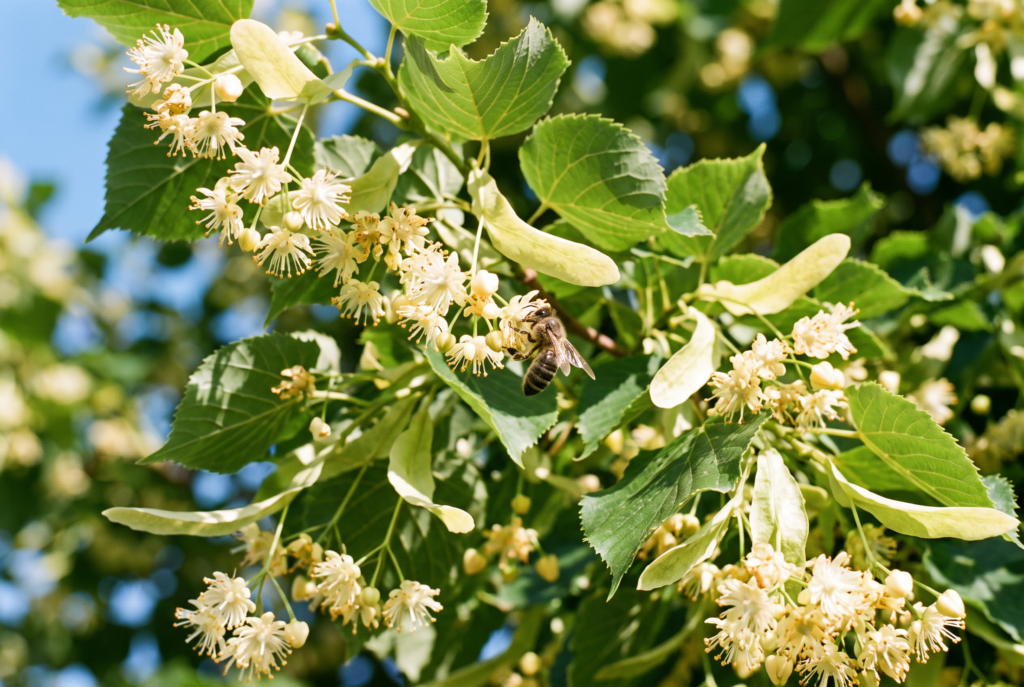
The small-leaved linden has whitish-green flowers. The catalogue names it as a tree along streets and waterways, as a single tree, in avenues and in pleached walks. In Leipzig I don’t have to look long: according to the Office for Urban Green and Waterways (Amt für Stadtgrün und Gewässer, 2016), the linden is the most common tree on Leipzig’s streets.
The large-leaved linden flowers in June, according to the fact sheet. There it is described as a village linden, a farmyard tree and an avenue tree.
What it gives the bees
According to the catalogue, the small-leaved linden supplies good to very good nectar and low pollen. For the large-leaved linden it says nectar good, pollen low. The fact sheet also calls it a honeydew provider. What honeydew is, is explained in Forest honey – what is it?. And what linden blossoms become in the jar, you can find under Linden honey.
According to LWG Bayern (the Bavarian state institute for viticulture and horticulture), both lindens belong to the summer forage. For Bavaria, July is given there.
Where they like to stand
The large-leaved linden stands in shade to partial shade, also in sun, on fresh, nutrient-rich loamy soils. The fact sheet does not recommend it for city streets; it is not salt-tolerant.


