


Several species go under the name goldenrod. The common goldenrod (Solidago virgaurea) is native. Canada goldenrod and giant goldenrod are established neophytes (non-native plants).
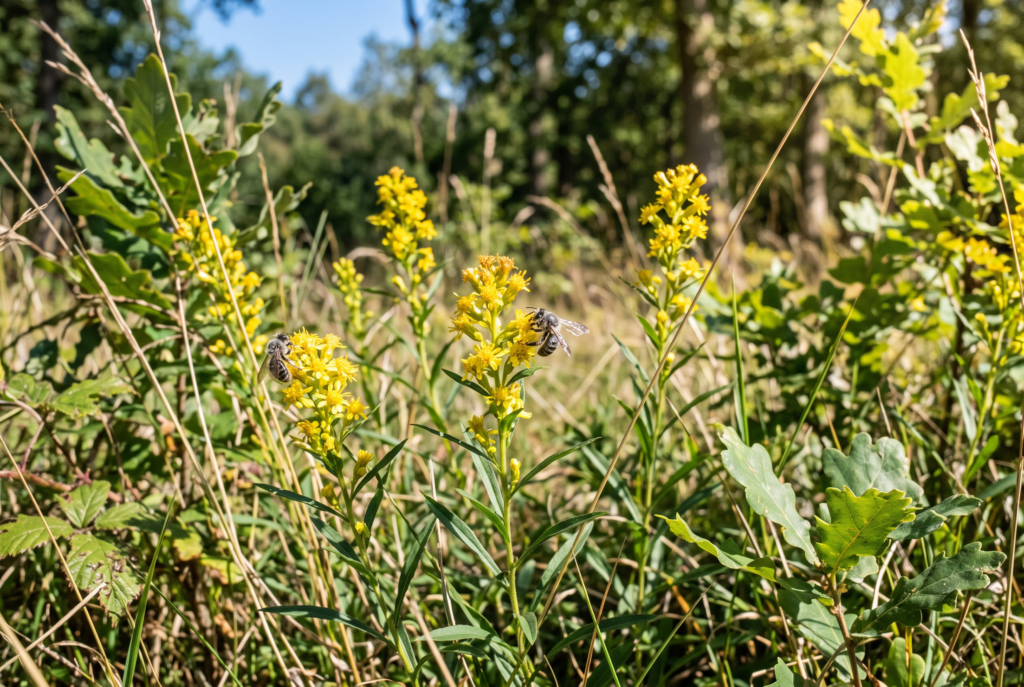
Fact sheet
- Species
- common goldenrod
- Status
- native
- Height
- 0.15–1 m
- Flowers
- July to October, yellow
- Site
- partial shade, loose soils
Sources of these details: BfN FloraWeb, Baden-Württemberg bee forage catalogue.
Contents
Which one suits the garden
The Baden-Württemberg bee forage catalogue lists the common goldenrod for perennial beds: partial shade, moderately fresh to dry, loose soils.
Canada goldenrod was originally an ornamental plant and today grows on riverbanks, roadsides, railway land and fallow ground. The Federal Agency for Nature Conservation (Bundesamt für Naturschutz, BfN) rates it and the giant goldenrod as invasive from a nature conservation point of view. Don’t plant either of them, and don’t spread them.
If it is already growing
According to BfN, controlling goldenrods is very difficult. What has proved effective is mowing twice, as low as possible, over several years: at the end of May and in mid-August.
In Saxony, the state office for environment, agriculture and geology (Landesamt für Umwelt, Landwirtschaft und Geologie, LfULG) evaluated a survey in 2012. Among the 43 neophytes named in it are Canada goldenrod and late goldenrod (Solidago gigantea, called giant goldenrod here). For Canada goldenrod, control is planned more often than has been carried out so far.
Late-summer forage
According to LWG Bayern (the Bavarian state institute for viticulture and horticulture), goldenrod and rosebay willowherb belong to the late-summer forage. The Baden-Württemberg bee forage catalogue states that in late summer it is mainly native species that are missing. One more reason for the native goldenrod.


