

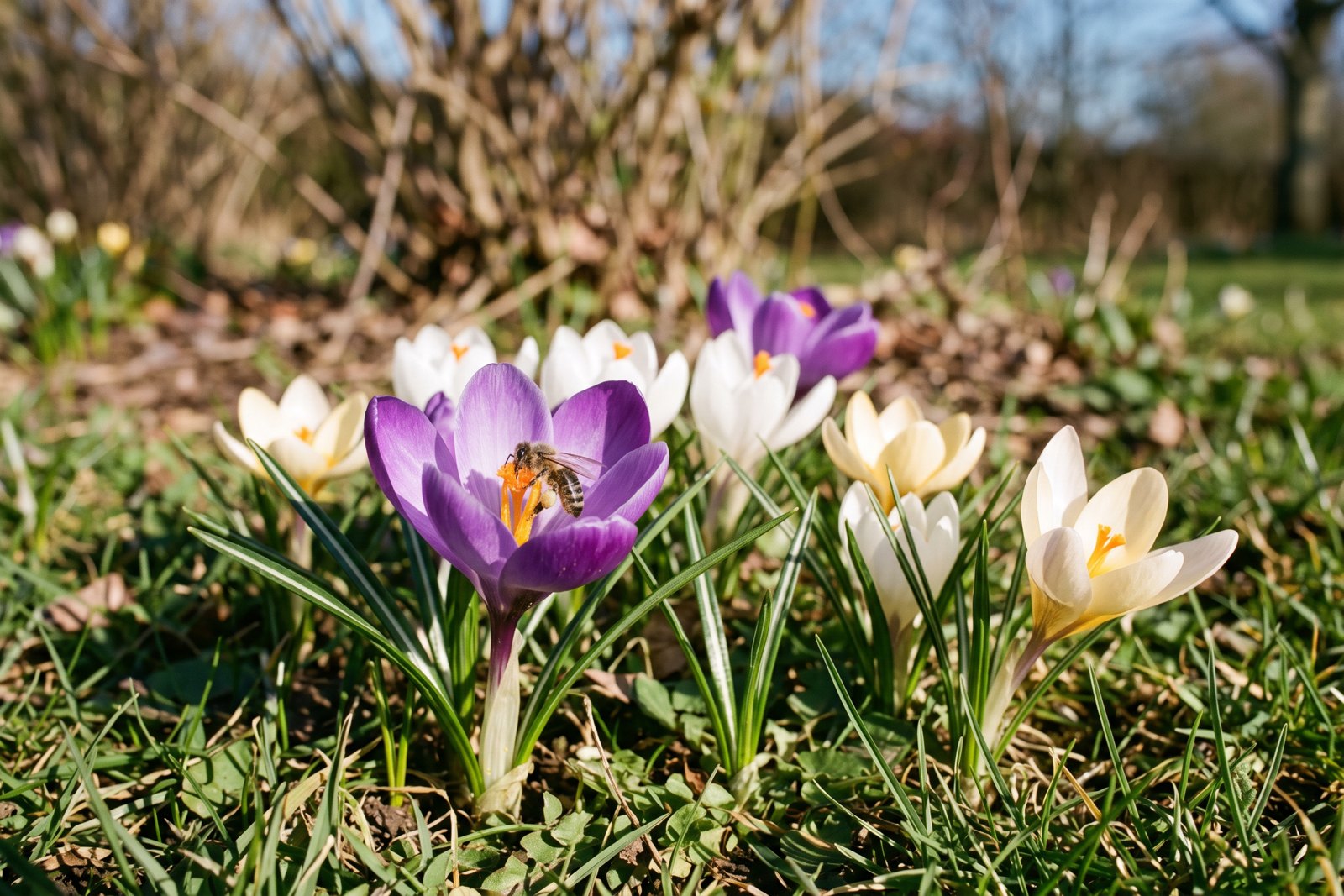
The spring crocus (Crocus vernus) flowers from February to April, in white, yellow or violet. It grows only six to fifteen centimetres tall, so it stays low, easy to see in the grass or at the edge of a bed.
Fact sheet
- Growth
- bulb plant, native
- Flowers
- February to April, white, yellow or violet
- Site
- sunny, fresh, humus-rich loamy soil
Source of these details: Baden-Württemberg bee forage catalogue.
Contents
Flowers and site
The crocus likes sun, on fresh, nutrient-rich, humus-rich loamy soils. According to the catalogue the species is native; the subspecies Crocus vernus subsp. vernus counts as a naturalised neophyte (a non-native plant). Its natural habitat is fresh to moist mountain meadows in the Alps and the Alpine foothills. In the garden, then, it will be happy with a spot that is open to the sun and does not dry out.
What it gives the bees
In the Baden-Württemberg bee forage catalogue, nectar is rated “good” and pollen “moderate”. Because of its early flowering time, the crocus is “highly recommended for bee forage” there. It belongs to the build-up forage (Entwicklungstracht), that is, the early food when the colony is building up.
In the garden
There are many cultivated varieties. The catalogue names rock gardens, beds and lawns as uses, so you can choose where it brings colour between February and April. In Germany the crocus is not endangered, but it is specially protected under the Federal Nature Conservation Act (Bundesnaturschutzgesetz). So don’t dig up wild plants; buy bulbs. Another early guest is the goat willow.


