
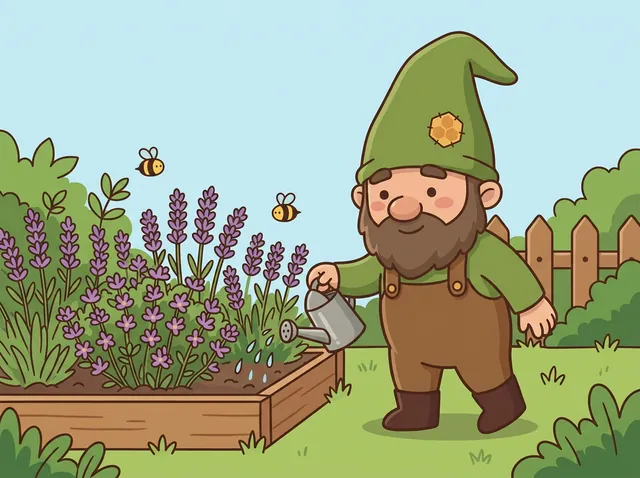

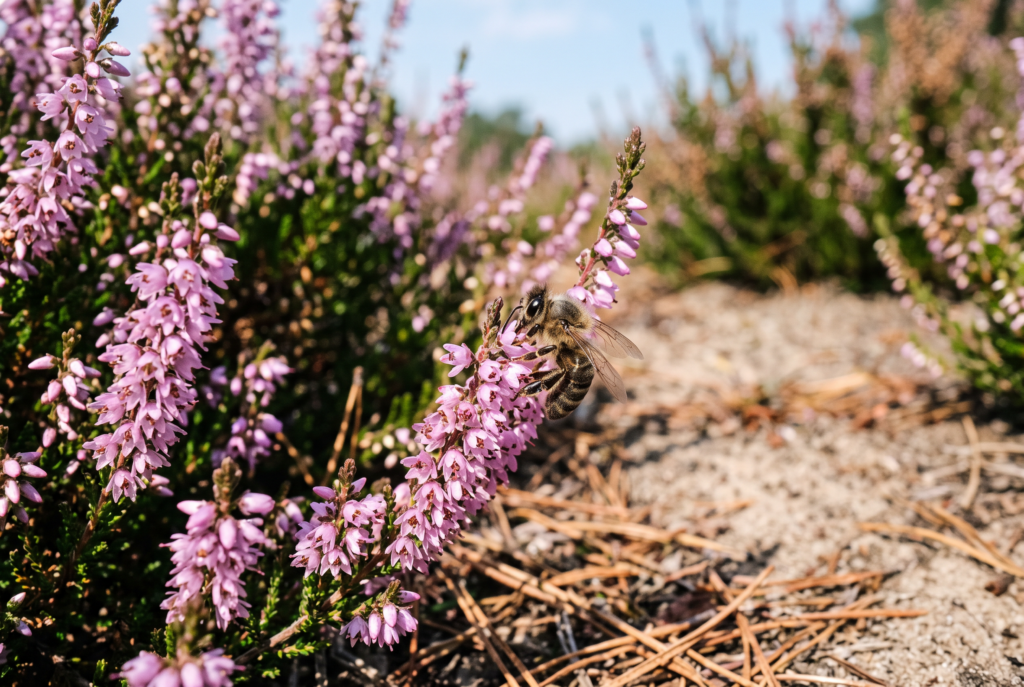
Heather (Besenheide, Calluna vulgaris) is a dwarf shrub 0.15 to 0.5 metres tall. In the Baden-Württemberg bee forage catalogue it flowers from June to October, in violet-pink.
Contents
What it gives the bees
According to the Baden-Württemberg bee forage catalogue, heather supplies very good nectar and low pollen. Outside settlements, in sandy areas, it is a forage plant for specialised wild bees.
Where it grows
Heather likes sun, and that is the first entry in the catalogue. The soil may be moderately dry to moist, low in nutrients and bases, and acidic.
Why late blooms count
According to LWG Bayern (the Bavarian state institute for viticulture and horticulture), heather belongs to the late-summer forage, together with goldenrod, mints, rosebay willowherb and ivy. In a project from 2019 to 2022, LWG studied late forage: balsam (Springkraut), heather and ivy can, depending on the region, be a significant late forage.
The bee forage catalogue names forage gaps, mostly from June to September and in January and February. In late summer it is mainly native species that are missing. The state bee institute in Celle (Landesinstitut) points out that the winter bees are raised in late summer and autumn. More on autumn at Ivy – one of the last of the year.


