

This page is for nursery teachers, teachers and parents. The week suits children aged 4 and over in nursery and grades 1 to 3 in primary school. It arranges Polli’s 17 questions, the stories and the colouring pages into five days. Every day has a theme and takes about an hour. You can also pick out just one day on its own.
How each day is built: one question to start · two or three answers from Polli to read aloud · one sheet to colour in · something to do · if you like, a short film or an audio story.
Contents
Day 1: The bee colony
Start: how many live in a beehive? Let the children guess.
- Read aloud: How many bees live in a beehive? · What does the queen do? · What do drones do? · How long does a bee live?
- Story: Why bees?
- Colouring: “The queen and her court” (PDF, in German)
- To do: draw a worker and a drone (idea on the page about drones).
- Watch and listen: film “Unter den Linden” (in German), to get to know Wabo and Lipsi · for quiet time, the fairy tale “Die Bienenkönigin” (The Queen Bee), read aloud by Nestor (in German).
Day 2: Who does what?
Start: what is a honeycomb made of? Who has ever seen a candle made of beeswax?
- Read aloud: How do bees build combs? · What do bees glue with? · How does honey get into the jar?
- Colouring: “The honeycomb made of hexagons” (PDF, in German) · “A look inside the beehive” (PDF, in German)
- To do: roll candles from beeswax foundation sheets.
- Watch and listen: film “Cousine Docht zieht Kerzen” (Cousin Docht dips candles; in German).
Day 3: How bees see and talk
Start: how many eyes does a bee have? Two? More?
- Read aloud: How many eyes does a bee have? · What colours do bees see? · How do bees tell where flowers are?
- Colouring: “The bee: head, thorax, abdomen” (PDF, in German) · “The waggle dance” (PDF, in German)
- To do: dance the bee dance (idea on the page about the dance) · Exploring bees.
- Watch and listen: listen to Polli’s questions as a conversation (in German) – in the Wichtel house (in German), room “Fragen” (Questions).
Day 4: Through the year
Start: where are the bees when it snows?
- Read aloud: Why do bees swarm? · How does a bee become queen? · How do bees cool their home? · Where are bees in winter?
- Story: “Where Is Lipsi?”
- Colouring: spring, summer, autumn, winter (PDF, in German) · “The winter cluster” (PDF, in German)
- To do: hang the four season sheets up in the right order · The bee year for families.
- Watch and listen: the story “Wo ist Lipsi?” as a film or just to listen to (in German).
Day 5: Bees and us
Start: what can we do for bees?
- Read aloud: Why do bees sting? · Are there other bees? · Why are bees important?
- Colouring: a plant from the garden, for example dandelion or sunflower (PDF, in German)
- To do: count flowers outdoors with the flower counting card · plant a snack box for bees · build a nesting aid for wild bees.
- Watch and listen: film “Wabos Runde durch Leipzig” (Wabo’s rounds through Leipzig; in German) · the poem “Die Bienen” (The Bees) by Gellert, read aloud by Nestor (in German).
- Finish: every child gets their own bee passport. If you like, make a mask. To the templates
For grown-ups
A few things beforehand.
- All templates may be printed and copied for use at home, in nursery and in school.
- Honey is not for babies under one year old. Honey and babies
- The pages for Polli’s questions have a “For parents” section with the sources.
- Films and audio stories play on the page of the story in question, with no sign-up and no ads. In a group room, one screen or one speaker is enough.
- For children who watch on their own on a tablet: the Wichtel house for children (in German).
- To see bees up close: places in and around Leipzig are listed under Bees in and around Leipzig, and dates for your diary under Events (in German).
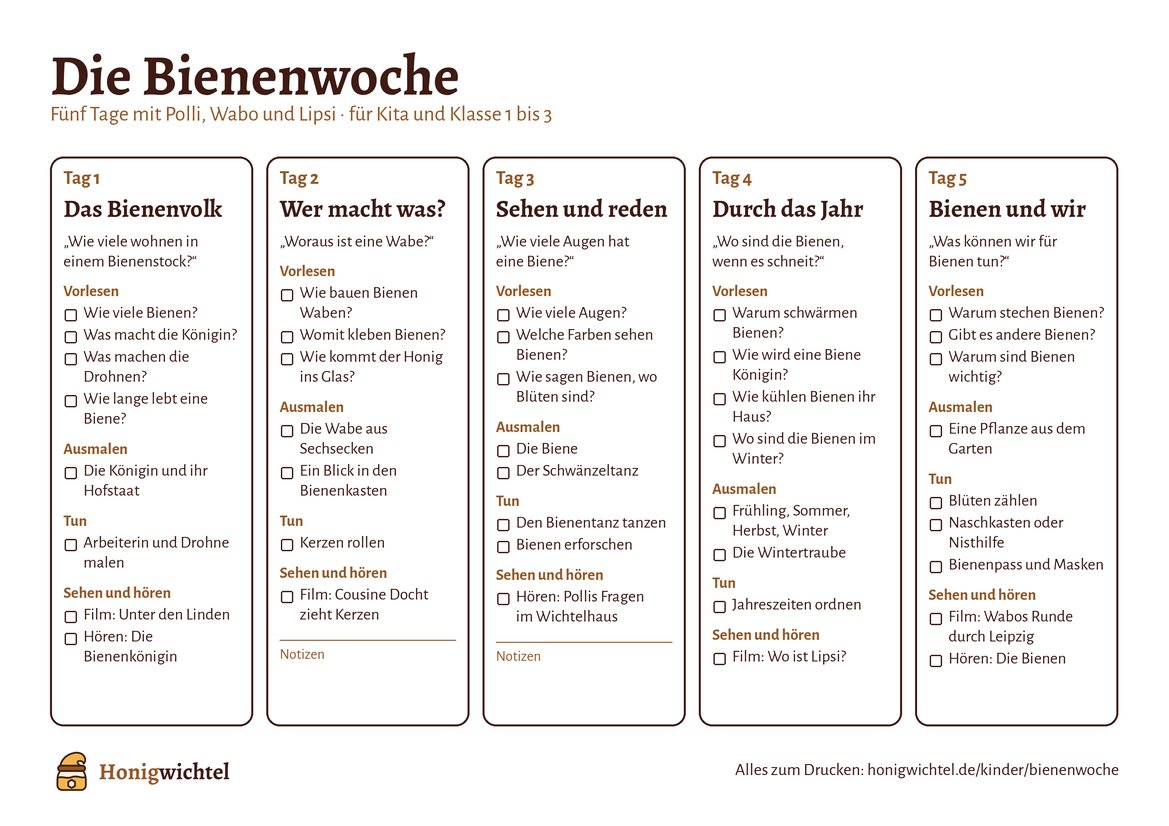
The week on one page, to pin up (A4) (PDF, in German)
Handout for nursery teachers and teachers (A4) (PDF, in German)


