
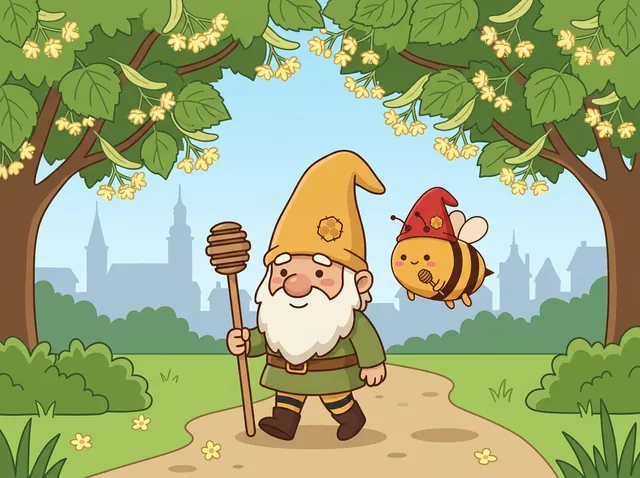
Leipzig and bees: that means above all gardens, a bee journal of its own and its beekeepers. The „Leipziger Bienenzeitung“ (Leipzig Bee Journal) appeared here monthly from 1886, the first Schreberverein (Schreber garden association) was founded here in 1864, and in 2016 the veterinary office (Veterinäramt) reported 193 beekeepers in the city (dpa).
Contents
Lime trees and the name of the city
For a long time, people said that Leipzig got its name from the lime tree, Slavic lipa. Linguists see it differently today. The oldest recorded form, Libzi (1012/18), has nothing to do with the lime tree; it was only later linked to lipa. The linguist Hengst reads the name as pointing to an area rich in water. The question is not fully settled.
Limes are still important for bees. In Germany, lime flowering begins in mid-June with the large-leaved lime (Sommerlinde). The small-leaved lime (Winterlinde) follows at the end of June. With the Crimean lime and the silver lime, it lasts until the end of July, about six weeks in all. It is the last major nectar flow of the year. You can read more about the honey from this blossom at Lime honey (Lindenhonig, in German). The Honey Atlas (Honig-Atlas, in German) shows which single-variety honeys are typical of Saxony.
In 2015, the Amt für Stadtgrün und Gewässer (Office for Urban Green and Waterways) counted about 61,000 trees along Leipzig’s streets (presentation at the Straßenbaum-Forum 2016, a street tree forum). The main species were lime, maple, plane and ash. On average, the trees were about 30 to 40 years old. According to the office (2016), the small-leaved lime is the most common.
The Bienenweidekatalog Baden-Württemberg (Baden-Württemberg bee forage catalogue) rates what limes offer bees: the nectar of the small-leaved lime „gut bis sehr gut“ (‘good to very good’), that of the large-leaved lime „gut“ (‘good’). Both supply little pollen. However, the catalogue considers the large-leaved lime unsuitable for city streets. The Bavarian specialist centre LWG counts maples as Frühtracht (early nectar flow), that is, among the early blossoms in the bee year. For plane and ash, we have no information in our sources on their value as bee forage.

Lots of limes!
Gardens: the first Schreberverein
On 10 May 1864, the first Schreberverein was founded in Leipzig, the Verein der Westvorstadt (West Suburb association). The idea came from the headteacher E. I. Hauschild. The association is named after the doctor Moritz Schreber. At first it was about a playground for children; the garden beds came later.
The Deutsches Kleingärtnermuseum (German Allotment Museum) shows this history in the association’s historic house, in the middle of a protected allotment site.
According to the city’s Maßnahmenkatalog (catalogue of measures), Leipzig has about 1,240 hectares of allotments on 273 sites, with over 38,000 plots.
How a garden becomes forage for bees is told in Thymian's garden year (Thymians Gartenjahr, in German).
The Auwald (floodplain forest) in spring
Before the trees in the Auwald unfold their leaves, spring snowflakes (Märzenbecher), wood anemones (Buschwindröschen) and corydalis (Lerchensporn) bloom on the ground. Between March and May, wild garlic (Bärlauch) also sprouts. The Auwald is one of the biggest sites of the spring snowflake in Saxony. The plant is specially protected: please look, but do not pick.
According to the Amt für Stadtgrün und Gewässer, the pedunculate oak (Stieleiche) is „die prägende Baumart im Leipziger Auwald“ (‘the defining tree species in the Leipzig Auwald’). In the 2025/26 season, the office had new pedunculate oaks planted in the Rosental and in Connewitz, and in Connewitz also wild cherries and wild pears. The Bienenweidekatalog rates the wild cherry (Vogelkirsche; sweet cherry) „sehr gut“ (‘very good’) for nectar and pollen.
The Leipzig Auwald is a hardwood floodplain forest (Hartholz-Auenwald), and that is rare in Saxony. In the mapping from 2006 to 2016, Sachsenforst found only 1,124 hectares, about 2.5 per cent of the possible area. Large contiguous stands were found only in the Leipzig Auwald. Typical trees there include pedunculate oak, ash, field elm, European white elm and field maple.
Beekeeping in Leipzig and Saxony
According to dpa, the Veterinäramt Leipzig reported 193 beekeepers with 2,033 colonies in 2016. That was almost 50 per cent more colonies than in 2015. For comparison, dpa gave 472 beekeepers with 2,500 colonies for Dresden. In the whole of Saxony in 2018 there were, according to the Saxon agriculture ministry (SMEKUL) based on data from the Tierseuchenkasse (animal disease fund), 55,508 colonies and 6,966 beekeepers. That was almost 39 per cent more colonies than in 2013.
The city of Leipzig itself, in its „Maßnahmenkatalog zum Schutz von Wild- und Honigbienen in Leipzig“ (‘Catalogue of measures to protect wild and honey bees in Leipzig’), assumes about 200 beekeepers with about 2,000 bee colonies. According to the catalogue, 314 bee species are known in Leipzig; about 28 per cent (87) are considered extinct or missing.
Under § 1a of the Bienenseuchen-Verordnung (Bee Diseases Ordinance), anyone who wants to keep bees must notify the competent authority no later than when they start, giving the number of colonies and the location.
In 2019, American foulbrood was found in Leipzig-Lindenau. In the restricted zone (Sperrbezirk), staff of the Veterinär- und Lebensmittelaufsichtsamt Leipzig (Leipzig veterinary and food inspection office) examined all colonies.
For getting started, the Bayerische Landesanstalt für Weinbau und Gartenbau (LWG, Bavarian State Institute for Viticulture and Horticulture) recommends starting with two colonies and attending a course with theory and practice. Beekeeping clubs are happy to welcome newcomers. For the next steps, see Beekeeping (Imkern, in German). We collect clubs, teaching apiaries and other places to go at Bees in and around Leipzig: where to go. In September 2029, the world beekeeping congress comes to Leipzig: Apimondia 2029 in Leipzig.
The 2026 honey harvest was, according to the Deutscher Imkerbund (German Beekeepers’ Association), 39.5 kilograms per colony. The north and the east of Germany were above average, above all the oilseed rape regions. You can find more figures in Honey in figures (Honig in Zahlen, in German).
How the Leipzig colonies came through the winter, what they harvested in 2026 and what the hive scale shows is given, with source and year, at How are the bees in Leipzig? (in German).
Clubs in the surrounding area
You can find the Leipzig clubs at Bees in and around Leipzig. These seven clubs in the surrounding area published dates or posts in 2025 or 2026 (as of 22 Nov 2026).
Landkreis Leipzig (Leipzig district)
- Grimma and District Beekeepers' Association (Imkerverein Grimma und Umgebung e. V.), Grimma, founded in 1861. Club meetings are monthly; guests are welcome.
- Naunhof and District Beekeepers' Association (Imkerverein Naunhof und Umgebung e. V.), Naunhof. On 28 March 2026, the club planted trees with the support of the town administration and three junior beekeepers.
- Imkerverein Borna und Umgebung e. V. (Borna and District Beekeepers’ Association), Borna, profile on the website of the Landesverband Sächsischer Imker (LVSI, Saxon Beekeepers' Association). The 2025 schedule is there, running until January 2026. There is no newer schedule there yet (as of 22 Nov 2026).
Landkreis Nordsachsen (North Saxony district)
- Taucha & District Beekeepers' Association (Imkerverein Taucha & Umgebung e. V.), Taucha. It meets monthly; the dates for 2026 are on the club’s website.
- Eilenburg and District Beekeepers' Association (Imkerverein Eilenburg und Umgebung e. V.), Eilenburg. Its dates are on the club’s website; the club is a member of the LVSI.
- Torgau and District Beekeepers' Association (Imkerverein Torgau und Umgebung e. V.), Torgau. The dates run until November 2027.
- Imkerverein Delitzsch e. V. (Delitzsch Beekeepers’ Association), Delitzsch, founded in 1867, profile on the LVSI website. The club introduces itself there; it names nine club meetings a year (as of March 2026).
The LVSI names further clubs in its list with map.
- Beekeeping club
- Place to visit
- both
- District boundary
© OpenStreetMap contributors, ODbL.
Places on the map and sources
Location: town centre according to OpenStreetMap (Nominatim, accessed 22 Nov 2026).
| Place | What | Type | Location (OSM) |
|---|---|---|---|
| Leipzig | Imkerverein Leipzig (see Bees in and around Leipzig) | Beekeeping club | OSM relation/62649 (town centre) |
| Liebertwolkwitz | Imkerverein Liebertwolkwitz (see Bees in and around Leipzig) | Beekeeping club | OSM node/195971159 (town centre) |
| Grimma | Imkerverein Grimma und Umgebung e.V. | Beekeeping club | OSM relation/422342 (town centre) |
| Naunhof | Imkerverein Naunhof und Umgebung e.V. | Beekeeping club | OSM relation/422341 (town centre) |
| Borna | Imkerverein Borna und Umgebung e.V. (2025 schedule) | Beekeeping club | OSM relation/420481 (town centre) |
| Taucha | Imkerverein Taucha & Umgebung e.V. | Beekeeping club | OSM relation/445118 (town centre) |
| Eilenburg | Imkerverein Eilenburg und Umgebung e.V. | Beekeeping club | OSM relation/445965 (town centre) |
| Torgau | Imkerverein Torgau und Umgebung e.V. | Beekeeping club | OSM relation/534447 (town centre) |
| Delitzsch | Imkerverein Delitzsch e.V. | Beekeeping club | OSM relation/444742 (town centre) |
| Districts | Boundaries | Leipzig; Landkreis Leipzig; Landkreis Nordsachsen |
History: bee journal, bee society, Zeidler (forest beekeepers)
The „Leipziger Bienenzeitung“, an „Organ für alle Imker deutscher Zunge“ (‘organ for all beekeepers of the German tongue’), appeared monthly in Leipzig from 1886.
As early as 1766, the pastor Adam Gottlob Schirach founded the „Physikalisch-oeconomische Bienengesellschaft“ (‘Physical-Economic Bee Society’) in Kleinbautzen in Upper Lusatia, the first such association in Germany. That is Saxony, not Leipzig, but it belongs to the history of beekeeping in the state.
Even older is Zeidlerei, keeping bees in the forest in hollow trees. In Central Europe, it has existed for at least 2,000 years. The word „zeideln“ comes from „schneiden“ (‘to cut’); referring to the combs.
Nestor tells you who taught and researched bees in Leipzig at Leipzig and bee research.
New in Leipzig
On 9 August 2026, the Asian hornet was confirmed for the first time in Saxony, in Leipzig-Grünau – a beekeeper had filmed it at his beehive. At the end of August, the nest was removed. The LfULG (Saxon State Office for Environment, Agriculture and Geology) asks people to report finds through its reporting portal, ideally with a photo, to keep at least five metres away from a nest and not to remove nests themselves.
In the Botanical Garden of Leipzig University, researchers counted 197 bee species on 45 days in 2022 (Hausotte & Burger, 2025).
In the UFZ project „Leipzig summt und brummt“ (‘Leipzig hums and buzzes’), beehives are fitted with sensors. According to the project sheet, schools can use the data on temperature and hive weight in lessons.
Advent in Leipzig
According to Leipzig Tourismus und Marketing, the tradition of the Leipzig Christmas market goes back to 1458. It is considered the second oldest in Germany. Pulsnitzer Lebkuchen (gingerbread from Pulsnitz) are sold at the market. The privilege of the Pulsnitz bakers for Pfefferkuchen (gingerbread) dates from 1558. The basic dough of flour and honey or syrup matures for weeks to months.
You can read what Advent looks like in the Wichtelhaus (gnome house) in Advent in the Wichtelhaus (Advent im Wichtelhaus, in German), and there is a recipe at Linda's gingerbread (Lindas Lebkuchen, in German).
Gnomes from Leipzig
The illustrator Fritz Baumgarten was born in 1883 in Reudnitz, which is now part of Leipzig; he died in Leipzig in 1966. The Stadtgeschichtliches Museum (City History Museum) keeps Advent calendars and postcards based on his designs. More about him: Fritz Baumgarten (in German).
Like Baumgarten, we are at home in Reudnitz. That is where our name comes from; the story is on About us (Über uns, in German). The Leipziger Wichtelhonig, which we first bottled in 2022, came from Engelsdorf and Sommerfeld.
Trips with children
27 day trips in and around Leipzig: gardens, floodplain forest, animal parks, boat and park railway, hands-on museums. For each place, a gnome tells you what they like there. Leipzig with children: the gnomes' day trips
On the map
The map shows the places on this page: the Auwald, the Deutsches Kleingärtnermuseum and the Markt (market square), where the Christmas market is held.
Also marked in yellow are the Veterinär- und Lebensmittelaufsichtsamt of the city of Leipzig and the meeting place of the Imkerverein Leipzig (according to the club’s website).
You can also see Reudnitz, Fritz Baumgarten’s birthplace and our home, the Stadtgeschichtliches Museum and the Imkerverein Liebertwolkwitz und Umgebung in the south-east of Leipzig. In a colour of their own we show Engelsdorf and Sommerfeld, where the Leipziger Wichtelhonig came from. To find out where you can meet bees in and around Leipzig, see Bees in and around Leipzig: where to go.
© OpenStreetMap contributors, ODbL · data from 15 and 17 Nov 2026.
Map data and sources
| Place | Source |
|---|---|
| Auwald: NSG Burgaue | OSM relation/6336894; WDPA 162642 |
| Auwald: NSG Elster- und Pleiße-Auewald | OSM relation/7480316; WDPA 318343 |
| Deutsches Kleingärtnermuseum, Aachener Straße 7 | OSM node/1493540257; address as on kleingarten-museum.de |
| Markt | OSM way/1311967238 (point = middle of the square) |
| Veterinär- und Lebensmittelaufsichtsamt (veterinary and food inspection office), Theodor-Heuss-Straße 43 | OSM node/869352686; address as on leipzig.de |
| Imkerverein Leipzig: meeting place Gaststätte Goldene Höhe, Virchowstraße 90 A | Club website (events) (in German); OSM way/148209194 |
| Imkerverein Liebertwolkwitz und Umgebung: contact address Alte Holzhausener Straße 1, 04288 Leipzig | Club website (About us, 17 Nov 2026) (in German); OSM way/465772274 |
| Reudnitz (district Reudnitz-Thonberg; point = OSM place marker, no district boundary in OSM) | OSM node/2696877901 (place=neighbourhood) |
| Stadtgeschichtliches Museum Leipzig, Böttchergäßchen 3 | OSM way/23732323 |
| Engelsdorf (district; point = OSM place marker, no district boundary in OSM) | OSM node/310240474 (place=suburb); where the Leipziger Wichtelhonig came from: information from Honigwichtel |
| Sommerfeld (district; point = OSM place marker, no district boundary in OSM) | OSM node/2105540069 (place=village); where the Leipziger Wichtelhonig came from: information from Honigwichtel |
| City boundary | OSM relation/62649 |
| Water, main roads | OSM, Overpass export (natural=water, waterway, highway up to secondary); east and south edge: OSM API 0.6, 17 Nov 2026 (tools/karten/daten/leipzig-rand.json) |


