

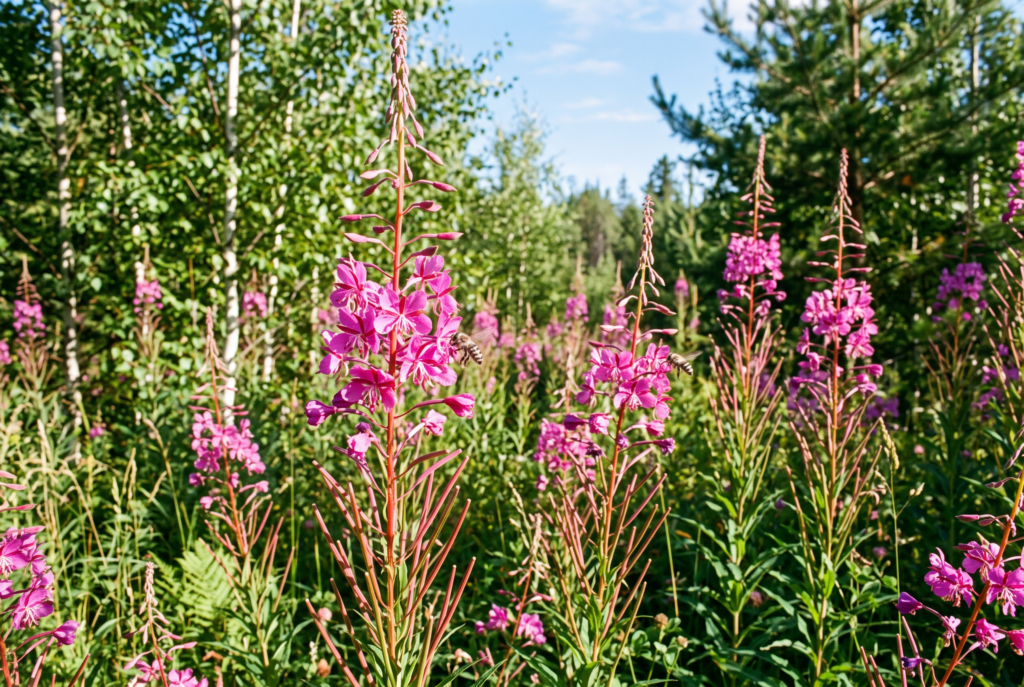
The rosebay willowherb (Schmalblättriges Weidenröschen, Epilobium angustifolium) belongs to the evening primrose family. According to BfN FloraWeb (the Federal Agency for Nature Conservation’s plant database), it is native and not endangered. It grows 60 to 120 centimetres tall, sometimes up to 200.
Fact sheet
- Growth
- perennial, native
- Flowers
- June to August, pink (Baden-Württemberg bee forage catalogue)
- Site
- sunny, preferably low in lime
Source of these details: Baden-Württemberg bee forage catalogue.
Contents
Flowers and site
The flowers are 2 to 3 centimetres across, purple-pink, rarely white. They sit in a many-flowered raceme at the end of the stem. The rootstock creeps far, and in winter the plant dies back above ground. You find it on recently felled woodland, in thickets and conifer plantations, on waste ground (Ruderalstellen) and in subalpine tall-herb communities. It avoids lime.
What it gives the bees
In the Baden-Württemberg bee forage catalogue, in the forest section, the rosebay willowherb counts among the “outstanding nectar providers”. According to LWG Bayern (the Bavarian state institute for viticulture and horticulture), it belongs to the late-summer forage, together with goldenrod, heather, mints and ivy.
The bee forage catalogue names forage gaps, mostly from June to September. In late summer it is mainly native species that are missing.
In the garden
The catalogue lists the rosebay willowherb as a perennial for natural gardens. It likes a sunny spot, on fresh, nutrient-rich, preferably low-lime soils. The rootstock creeps far – plan for space. Another late bloomer is the goldenrod.


