

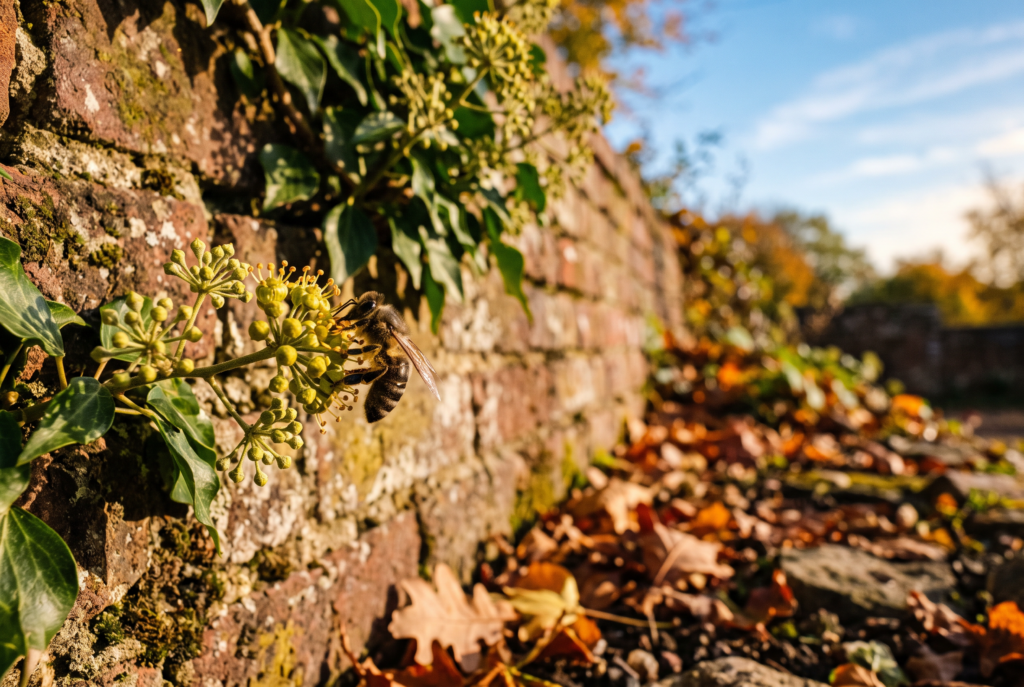
Common ivy (Hedera helix) is a woody climber and can grow up to 20 metres tall. In the Baden-Württemberg bee forage catalogue it flowers from August to October, with yellow-green flowers. The catalogue calls it an autumn bloomer and therefore an important forage plant.
Contents
What it gives the bees
Nectar good, pollen moderate: that is what the catalogue says. The Saxon state office LfULG lists ivy in its garden list as a climber for bees and many other insects.
Where it grows
According to the catalogue, ivy likes shade to partial shade, on fresh, nutrient-rich, loose loamy soils. The catalogue gives its height as 0 to 20 metres.
Why autumn matters
The bee forage catalogue names forage gaps, mostly from June to September and in January and February. In late summer it is mainly native species that are missing, and the state bee institute in Celle (Landesinstitut für Bienenkunde) points out that the winter bees are raised in late summer and autumn. Then an ivy can help at the right time. It flowers in late summer and lasts into October.
LWG Bayern (the Bavarian state institute for viticulture and horticulture) studied late forage in a project from 2019 to 2022. Balsam (Springkraut), heather and ivy can, depending on the region, be a significant late forage. Late forage does not necessarily lead to problems with overwintering; results were better or worse depending on the year.
According to the bee forage catalogue, ivy honey crystallises hard, which is an overwintering risk for beekeepers. Why honey sets at all is explained in Why does honey crystallise?.
Ivy is not a solution for everything, but part of the answer to one question: what is in bloom in autumn?


