

Anyone planting thyme in the garden has a choice. The Baden-Württemberg bee forage catalogue lists three species that differ in size, flowering time and site.
Contents
Three thymes
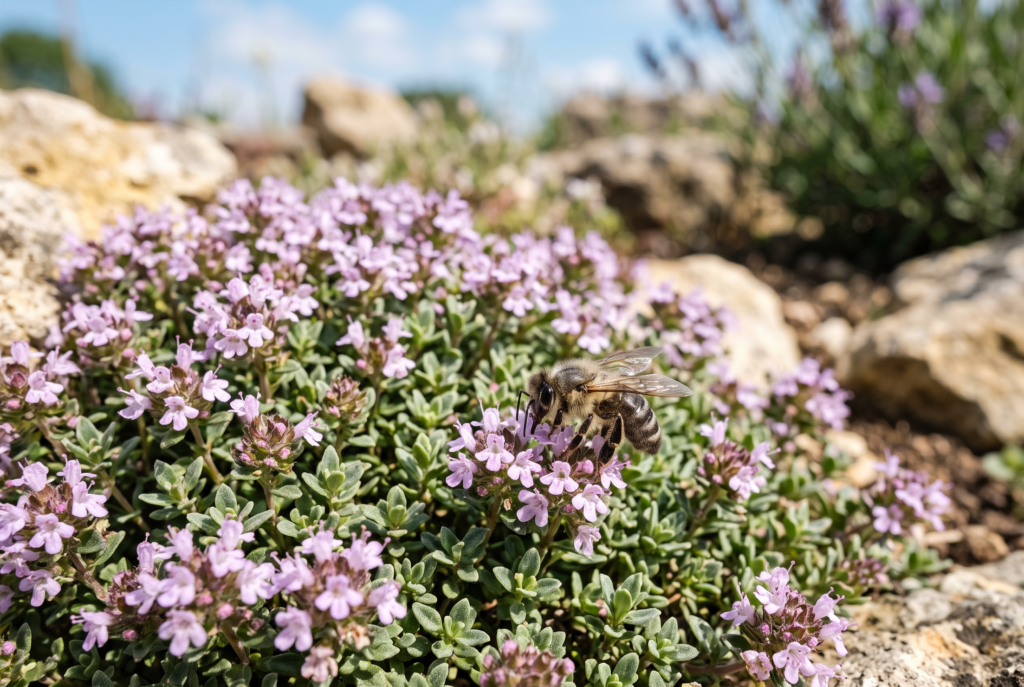
Common thyme (Thymus vulgaris) grows 0.2 to 0.4 metres tall and, according to the catalogue, flowers from May to October, in pale lilac, pink or white. Nectar good to very good, pollen low. It likes a sunny, dry spot.
Broad-leaved thyme (Feld-Thymian, Thymus pulegioides) stays lower at five to twenty centimetres and has reddish-violet flowers, June to September in the catalogue. Nectar good, pollen low. It likes partial shade to sun, on fresh to dry soils. The catalogue names rock gardens and dry-stone walls as places for it. For Saxon gardens, LfULG names sand thyme (Sand-Thymian), a wild species and not the garden thyme, 5 to 10 centimetres tall, with bees, hoverflies and butterflies as guests.
Lemon thyme (Thymus × citriodorus) grows 0.1 to 0.3 metres tall and, according to the catalogue, flowers from June to September. It likes a sunny, dry spot. For nectar and pollen the catalogue gives no figures for it. There it counts as a partner for balcony snack boxes (Naschkästen).
All months apply to Baden-Württemberg. For Leipzig I name none, because I have no source for it.
On the balcony
Thyme suits the balcony. The state bee institute in Celle (Landesinstitut für Bienenkunde) recommends it for the balcony, together with lavender, hyssop, flowering chives, borage, sage and lemon balm. If you let the chives flower, they belong there too.
Why it pays off
For common and broad-leaved thyme the catalogue gives pollen as “low”; for lemon thyme there are no figures. But common thyme flowers for a long time: from May to October, so six months in the catalogue. For common and lemon thyme the catalogue names a sunny, dry spot.


