

Phacelia is an annual and grows 0.2 to 1.2 metres tall. In the Baden-Württemberg bee forage catalogue its flowering time is June to August. Its home is far away: according to the Lower Saxony state bee institute in Celle (Niedersächsisches Landesinstitut für Bienenkunde), it comes from California and Arizona, and from Baja California in Mexico.
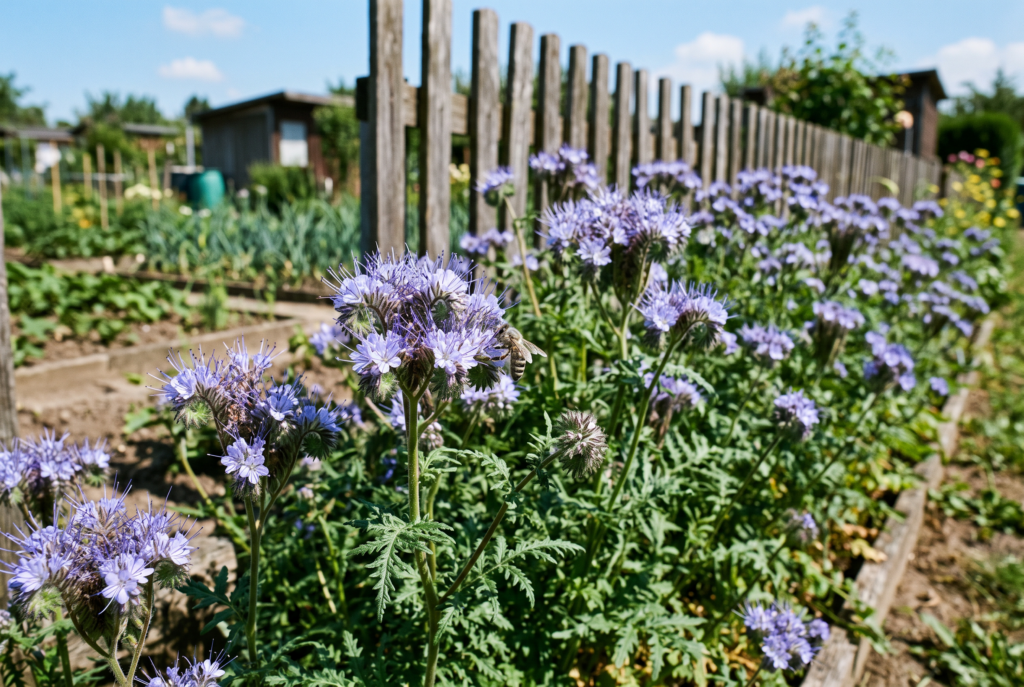
Flowering begins after six to eight weeks, and then it lasts at least three to four weeks.
Contents
What it gives the bees
Very good nectar, good pollen: that is how the Baden-Württemberg bee forage catalogue rates it. The institute in Celle writes that nectar production is usually very good; the pollen loads, that is, the little packets of pollen on the bees’ legs (Pollenhöschen), are relatively small.
When it flowers – and for how long
Flowering begins six to eight weeks after sowing. Each flower cluster opens only two or three flowers a day. That is why flowering lasts at least three to four weeks. This is phacelia’s gift: it does not bloom all at once, but for a long time.
Where and when to sow it
Phacelia is undemanding. It grows in partial shade to full sun, best on fresh, loamy sandy soils. The catalogue gives one tip with an exclamation mark: “sow early!” The reason: bees fly only in favourable weather.
In farming, phacelia is grown as a catch crop. The catalogue considers it particularly suitable for flower-visiting pollinators.
A bed of phacelia will not rescue the bees. It is one of many plants that together carry the bees through the year. It helps in summer, just as the willow helps in spring and the ivy in autumn.


