
Polli holds up his magnifying glass and asks Nestor. “From scientists,” says Nestor. “They looked very closely.”
In short
- Karl von Frisch studied bees with little dishes of food and coloured cards
- Bees smell with their antennae, and drones have lots of sensory plates
- Researchers counted flower visits in Leipzig and eight other cities
- In Halle, Würzburg and Düsseldorf, too, people are researching bees
- You can count flower visits without catching a single bee
Contents
A scientist who listened to bees
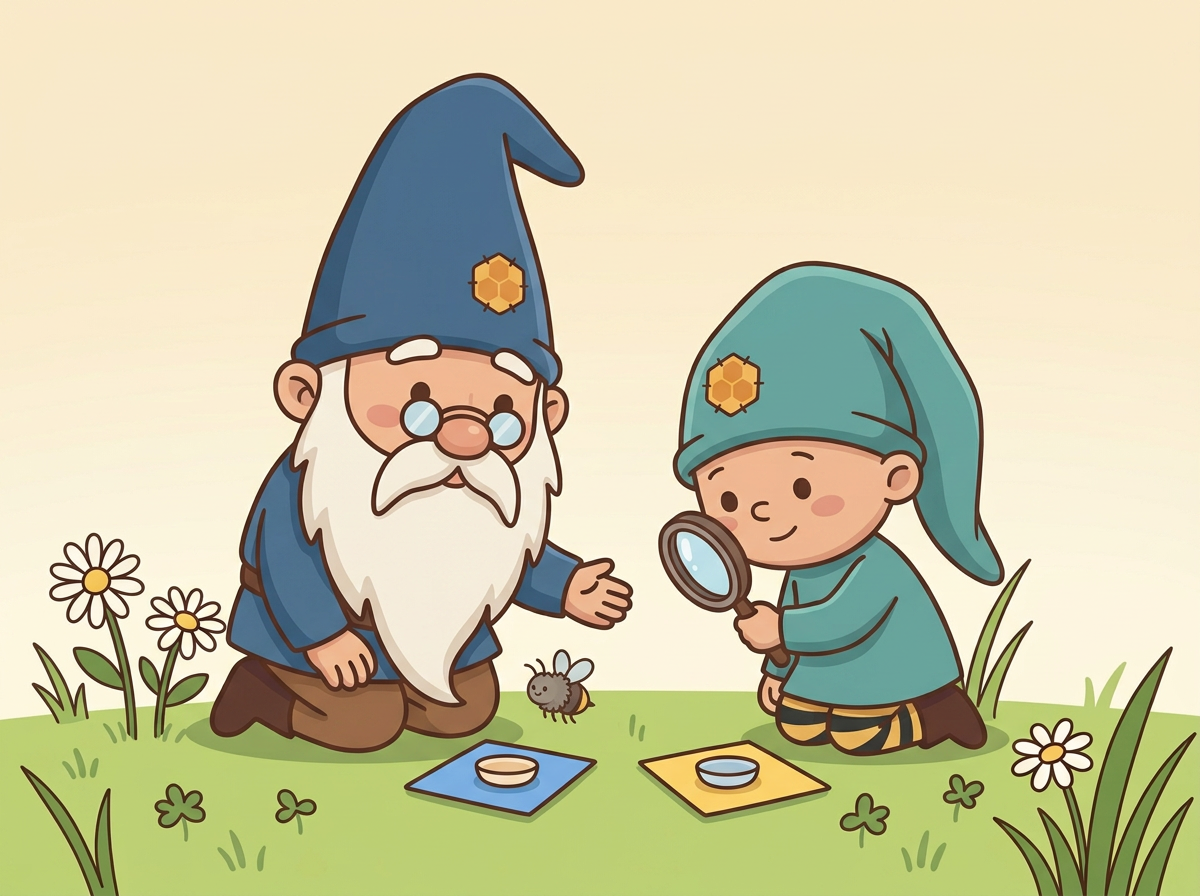
Nestor: “Karl von Frisch was born in Vienna in 1886. He died in 1982.” “In 1973 he received the Nobel Prize in Physiology or Medicine, together with Konrad Lorenz and Nikolaas Tinbergen. They studied how animals behave.”
Polli: “How did he do that with bees?”
Nestor: “He put a coloured piece of paper in among grey ones. Only on the coloured one was there a little dish of sugar water. The bees learned the colour.” “After that, empty dishes were standing everywhere. The bees flew to the colour where they had fed. They remember the colour for many days.” More about colours: What colours do bees see?
Polli: “And what about scent?”
Nestor: “He tested that too. Peppermint oil was put at the feeding place. New bees from the hive then looked for dishes that smelled of peppermint, and left dishes with other scents alone.”
Nestor: “Later he found out that bees dance when they have discovered food.” You can find out how the dance goes at How do bees tell where flowers are? “Frisch showed even more. Even when the sun was hidden, the bees still danced correctly. A patch of blue sky was enough for them. They can see a pattern there that we cannot see.” “And they have an inner clock. The sun moves across the sky, and the bees take that into account.”
How bees smell
Polli: “Where is a bee’s nose?”
Nestor: “Bees smell with their antennae.” “Sensory plates for smells sit on them: about 3,000 on a worker and about 30,000 on a drone.” And what about the eyes? Find out here: How many eyes does a bee have?
Research in Leipzig and elsewhere
In a study published in 2020, researchers from iDiv (the German Centre for Integrative Biodiversity Research), the University of Halle and UFZ (the Helmholtz Centre for Environmental Research) compared nine German cities with their surrounding countryside, Leipzig among them. They looked at who visits red clover. About three quarters of the visits were made by bumblebees. Honey bees accounted for 8.7 out of every 100 visits. The figures apply to all nine cities taken together. That means many other insects pollinate too. You can read more about this at Wild bees.

And who else does research?
Who pollinates the apple tree? In Halle, not far from Leipzig, experts at the university study bees. In and around Halle they look at how much different insects contribute to pollination, especially of the apple tree, in town and in the countryside. One of their papers from 2021 says it right in the title: when honey bees fly to flowering oilseed rape, wild bees pollinate the apple blossoms.

Lots of helpers!
Do bees learn? At the University of Würzburg, researchers look at how bees behave, how they learn and how they share out their work in the colony. A paper from 2023 explores the question of why some bees learn better than others.
Drone or worker? Eggs that are not fertilised become drones. Fertilised eggs usually become workers or queens. Whether that works depends on one particular gene. Researchers at the University of Düsseldorf found this out. As early as the middle of the 19th century, the parish priest Johann Dzierzon had an idea about where drones come from.
An old question!
Watch for yourself
Join in
Counting flower visits (idea from Bavaria, ANL – the Bavarian Academy for Nature Conservation and Landscape Management)
- Find a garden with lots of flowers. Between May and August works well, on a warm, dry day without wind, best in the morning.
- Go there slowly and quietly. If your shadow falls on the flowers, the insects flee. Then wait a moment.
- Look through the magnifying glass without catching anything. Count who visits which flower, for example on lavender, sage or thyme.
- At the end, talk about who went where.
Watching flower loyalty (idea from Bavaria, LWG – the Bavarian state institute for viticulture and horticulture)
Find a bee on a dandelion or white clover. Does it stay with the same plant? Count how many flowers it visits one after another. Repeat it with more bees. The numbers are different every time, and that is normal.


