
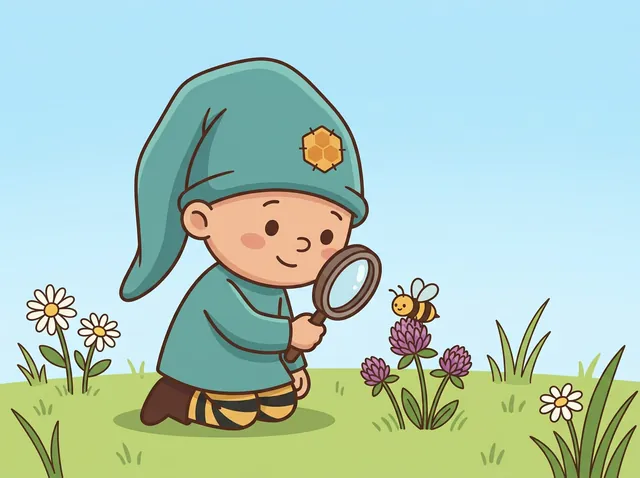

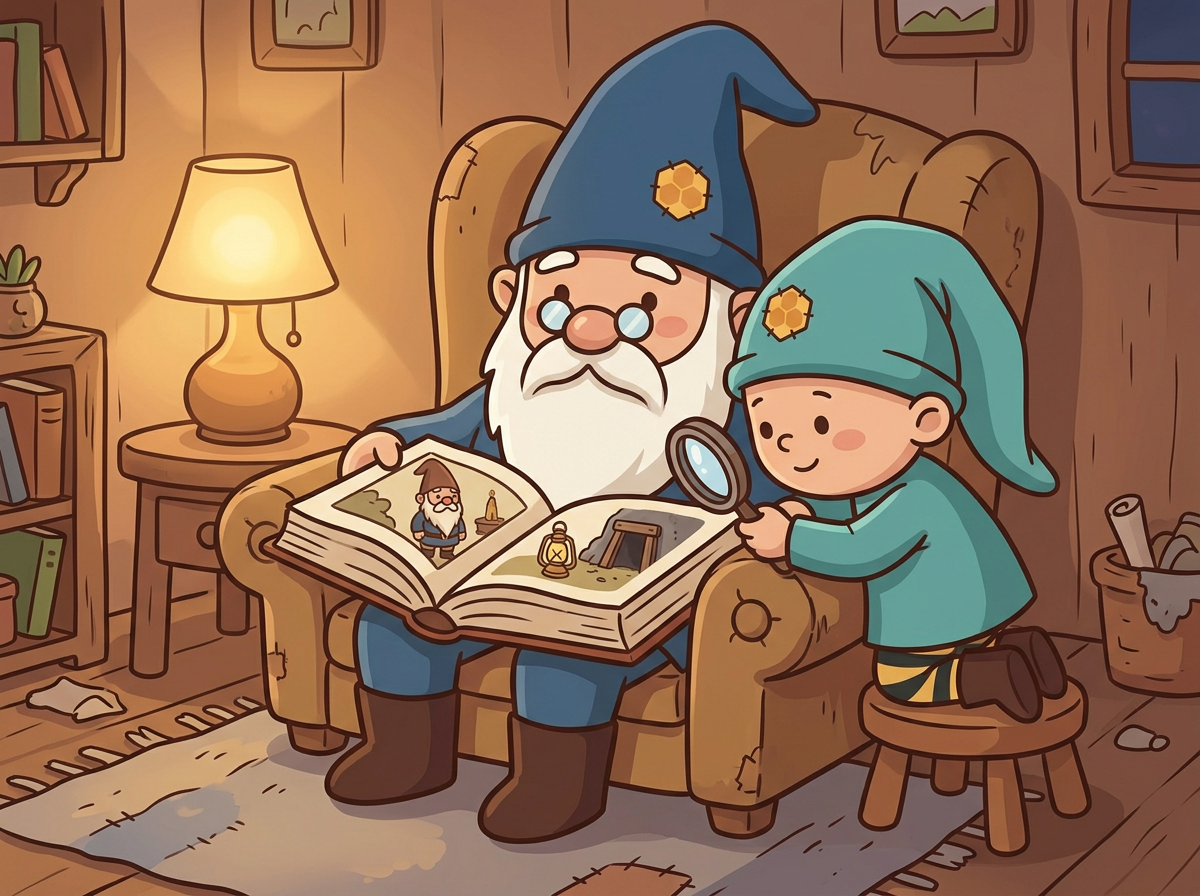
Polli has heard about Cousin Fichtel. Fichtel is Wabo’s cousin, a mine Wichtel (gnome) from an old pit in the Ore Mountains (Erzgebirge). He is a made-up character, like everyone in the Wichtelhaus. Polli asks Nestor: “Were there gnomes in the mines?” Nestor fetches another book.
“Underground” means: under the earth, in the mine.
Contents
The Wichtlein of the Brothers Grimm
In 1816, in their Deutsche Sagen (German Legends), the Brothers Grimm wrote down number 37: “Die Wichtlein”. Wichtlein, or Bergmännlein (little mountain men), look like dwarfs. They are about three quarters of an ell tall, an old unit of length. They are little old men with long beards, dressed as miners. They seldom do any harm, as long as nobody teases or insults them. If they show themselves in tunnels with a lot of ore, that is, rock with metal in it, it counts as a good sign. Among the sources the Grimms drew on was Georg Agricola. In Idria, it is said, people put out food for them and give them a little red coat once a year.
This is a legend. People told it and wrote it down. It is not proof.
Mountain spirit or little mountain man?
In his Deutsches Sagenbuch (German Book of Legends), Ludwig Bechstein explains the difference. The Berggeist (mountain spirit), also called Bergmönch (mountain monk), is usually a giant and comes alone. He hates swearing. Bergmännchen, on the other hand, are earth goblins from the dwarf folk, often in crowds. You are not supposed to mix them up.
Kirnbauer writes that mountain men, dwarfs and goblins are always small spirits of the mine. The mountain spirit helps, rescues and warns, and he does not put up with unnecessary noise. So the legends do not all agree.
Little mountain men at a glance
- In Grimm
- Deutsche Sagen no. 37 “Die Wichtlein” (1816)
- Looks
- small old men, long beards, miners’ clothes
- Mountain spirit in Bechstein
- usually a giant, alone
- Bergmännchen in Bechstein
- earth goblins, often in crowds
- Mountain spirit
- hates swearing (Bechstein), does not tolerate unnecessary noise (Kirnbauer)
- Little mountain men in Grimm
- seldom do harm, as long as nobody teases or insults them
The mountain spirit in the Christmas mountain
The Museum für bergmännische Volkskunst (museum of miners’ folk art) in Schneeberg has mechanical Weihnachtsberge, “Christmas mountains”: displays with moving figures. The mountain spirit keeps turning up there, writes TU Chemnitz. Visitors like to look for him. There were also little wooden mountain men, that is, carved figures. They probably served as table decorations at times, writes Sieber.
The Mettenschicht
The Mettenschicht was the miners’ last shift before Christmas. Siegfried Sieber describes the Mettenschicht in the Himmelsfürst mine near Freiberg: it began at 4 a.m. on 24 December. Twelve candles stood in the window in three rows, and the miners donated them themselves.
What we do not know
We have not found a source for mountain-man dwarfs in the Ore Mountains in particular. The Grimm example names Idria. From Saxony we know the mountain spirit, for example from the legend “Der Berggeist zu Annaberg” (The Mountain Spirit of Annaberg). We also know the “Wild Man”, the “Black Monk” and the Graumännchen (little grey man), a treasure guardian. So Cousin Fichtel is our own invention.
In episode 6 of season 1, Wabo visits his cousin: “An Arch for the Window” (coming on 10 December 2026).


