

In brief: you check whether honey is ripe with the shake test (Spritzprobe): when you hold a comb flat and give it a sharp jolt, not a single drop may fall. For the harvest you need equipment for sweeping bees off, for uncapping, an extractor, and very fine sieves (“feinst” or “extrafein”, 0.20 mm mesh). The extraction room should be clean and bee-proof.
Contents
Timing and the shake test
According to the info letter 10/2024 from Bienen@Imkerei (co-publisher: Länderinstitut Hohen Neuendorf), you take the combs out in the morning if possible, and shortly before a new major nectar flow. If the hive scale shows the weight rising, you do not harvest. If it stays constant for about a week or falls, little nectar is coming in and processing is under way. How to read the scale is explained on Hive scale.
For the shake test, you hold a partly capped comb flat over a level surface and give it a sharp jolt. Not a single drop may fall.
Sweeping the bees off
According to the info letter, you sweep the bees off only once. With more than a handful of colonies, the letter names a bee-brushing machine (Abkehrgerät) as effective; it says 10 colonies can be cleared in half an hour. First you do all the work in the brood chamber, then you take off the honey.
Uncapping
From Bavaria, the LWG (honey course, module 2, as of 12/2021) names this equipment:
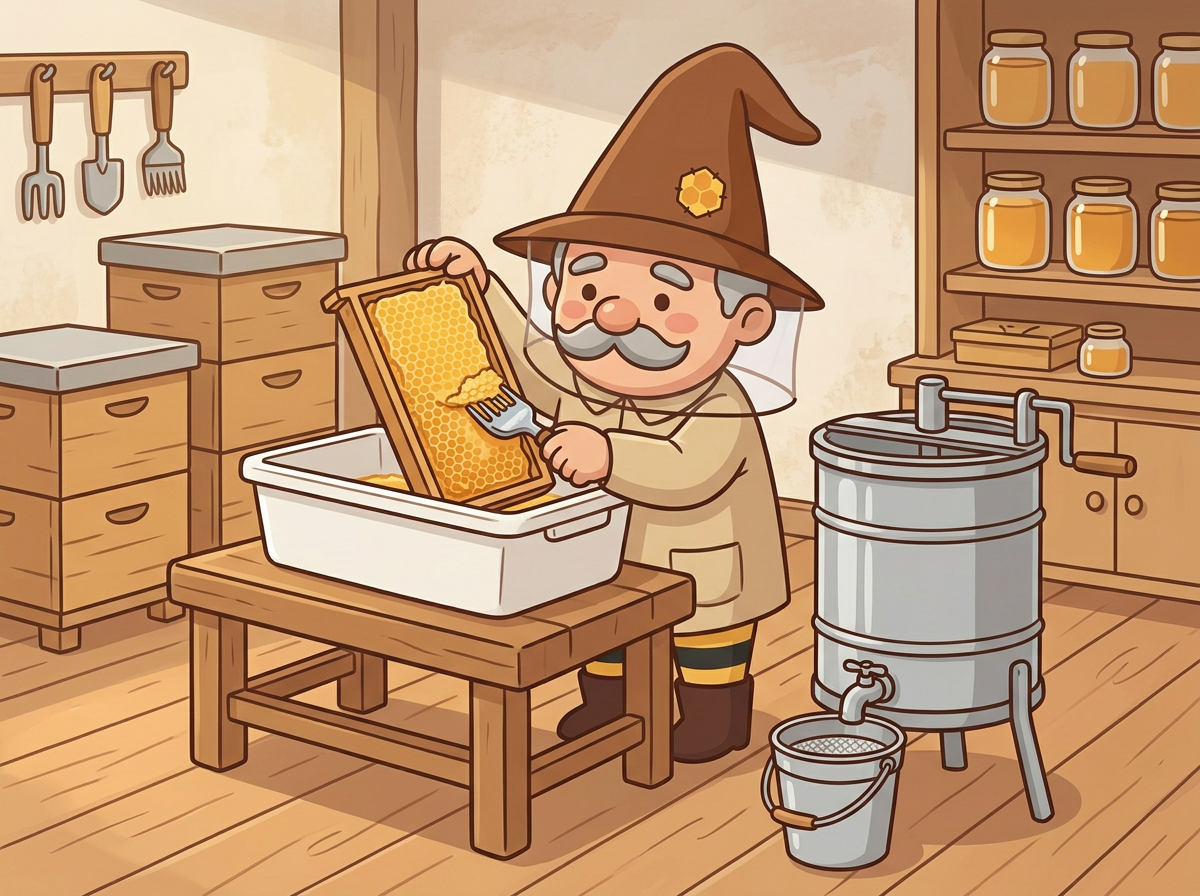
- An uncapping set consists of a food-grade plastic tub, a stainless-steel draining sieve and a comb rest.
- The uncapping fork with curved stainless-steel tines is an all-round tool, according to the LWG.
- The knife with a curved, serrated blade suits combs that are not built up so high.
- The hot-air gun is suitable only for high, white cappings. It needs touching up and cleaning afterwards and does not give you cappings wax for foundation sheets.
Extracting
According to the info letter 13/2024, the extraction room should be clean and bee-proof, have running water and be about 25 °C; the honey then runs out of the combs better.
With a tangential extractor, you start spinning gently, turn the combs, and only then go faster; otherwise the combs may break. A radial extractor needs no turning; you increase the speed slowly. The combs stand with the cells tilted slightly upward and the top bar pointing in the direction of rotation. A common beginner’s mistake is an overfull or slipped bucket under the honey gate (Quetschhahn).
Sieving
According to the Länderinstitut’s recommendations (2019), wax particles in honey mean the sieves are too coarse. Metal sieves are mostly not fine enough, and neither is the nylon conical sieve labelled “fein” (fine). The recommendation is “feinst” (finest) or “extrafein” (extra fine) with 0.20 mm mesh. A coarse sieve goes under the extractor, followed by a conical sieve. A 0.35 mm sieve lets visible wax particles through.
From Bavaria, the LWG (2021) adds: the meshes range from 1.8 × 0.7 mm (coarse) to 0.2 × 0.12 mm (fine). Keep a second sieve ready. After sieving, let the honey stand for a few days at room temperature and skim off the foam.
Hygiene in the extraction room
According to the LWG (2021, from Bavaria), hobby beekeeping counts as “occasional production” (“fallweise Produktion”). A kitchen or laundry room can serve as a temporary room, but not at the same time as cooking, eating, washing or processing wax. You remove waste and strong-smelling materials, clean the surfaces thoroughly and keep pets out. Untreated wooden surfaces do not belong in the room, and the equipment is made of food-grade material. You wear a clean coat, apron and head covering, and smoking is forbidden. The first cleaning of the equipment is always done with cold water, otherwise the wax smears.
What happens to the honey next is on Bottling and storage.

Spin gently.


