

In short: for a swarm on an overhanging branch, LWG Bayern lists a light container, a water sprayer, a queen cage, an empty box, pruning shears and a bee brush. Where the swarm is hard to reach, LWG puts your own health above the swarm.
Contents
What to have ready
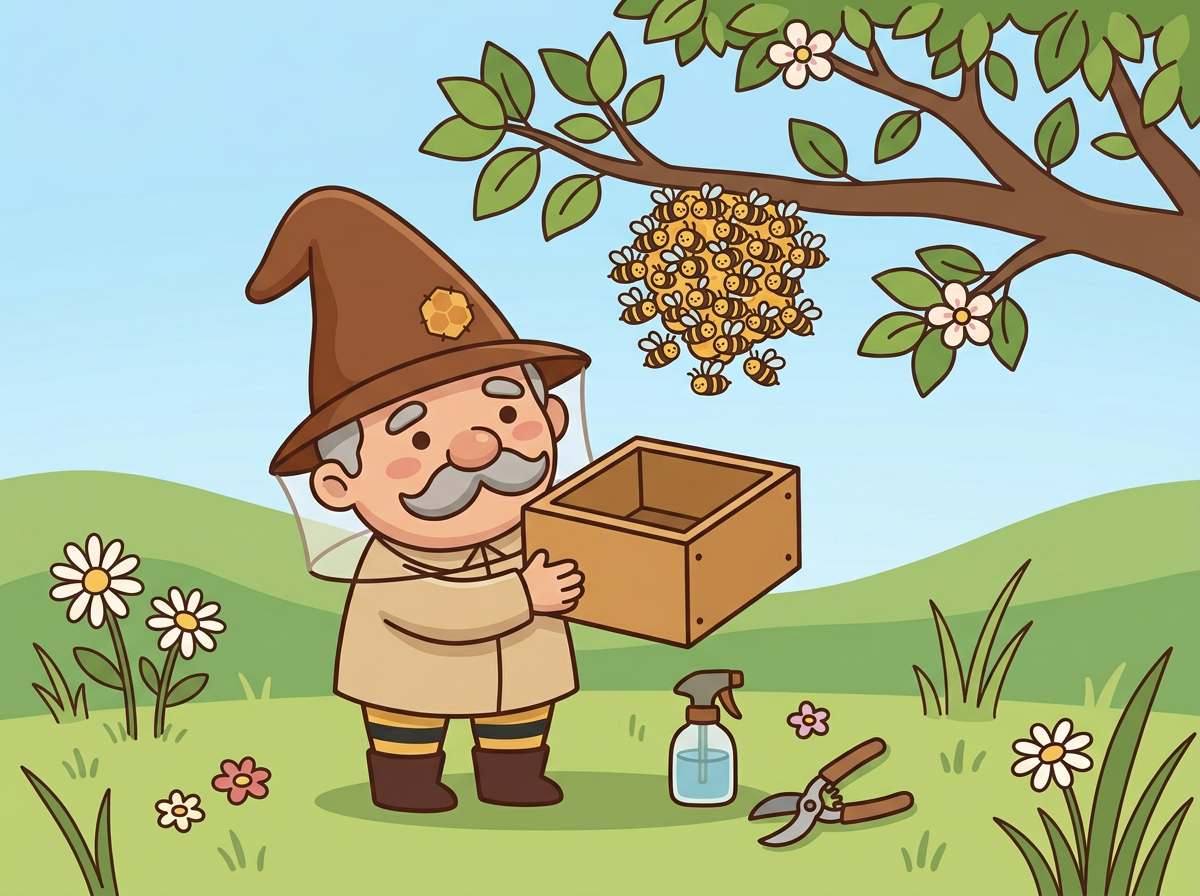
For a swarm on an overhanging branch, LWG Bayern lists: a light container (a light bee box or a swarm-catching basket), a water sprayer so the swarm draws together, a cage for the queen and an empty box. Add pruning shears and a bee brush. As a queen cage it suggests, for example, a hair curler, with about 20 cm of frame wire to fix it inside the box.
Steps at the branch
LWG describes these steps:
1. Cut a clear space around the cluster.
2. Spray the swarm with water.
3. Hold the box, with its floor closed, under the cluster and give the branch a hard knock.
4. Set the box on the ground, hang in foundation, put the lid on and open the entrance.
According to LWG, you can move the box a short distance. Longer distances you drive in the evening, once the bees have stopped flying.
Any swarm you catch may bring disease with it; for this, LWG points to a quarantine apiary.
When the swarm flies off again
In hot weather the swarm may leave again, says LWG. What helps then, by its account, is cellar confinement (cool and dark) or a brood comb hung in the box (Bannwabe).
Places that are hard to reach
If you cannot find the queen, LWG describes this approach: fix a box with floor and lid so that its open entrance touches the cluster, with a brood comb (Bannwabe) inside. With a brood comb, the colony usually moves in, queen included.
LWG stresses: your own health matters more than the swarm. The source gives no rules for ladders or working at height.
How high is it hanging?
On height, LWG writes: a swarm at 2 to 3 m often has the old queen (prime swarm); at 8 to 10 m it probably has a young queen (cast).
Suspected foulbrood
If foulbrood is suspected in a swarm from a neighbouring restricted zone (Sperrbezirk), LWG strongly recommends cellar confinement: three days without combs and without feed, then foundation and 1:1 sugar water, plus a quarantine apiary.
LWG points out that under the German Bee Diseases Ordinance (Bienenseuchenverordnung), empty hives containing combs must be kept closed.

Health first.


